Why do they Call it "Corned" Beef?
The term “Corned” comes from putting meat in a large crock and covering
it with large rock-salt kernels of salt that were referred to as “corns of salt”
This preserved the meat. The term Corned has been in the Oxford English Dictionary
as early as 888 AD.
Irish Were the First Exporters of Corned Beef
Irish were the biggest exporters of Corned Beef till 1825.
The English were serving corned beef but also the Irish. In this day and age
corned beef and cabbage is not very Irish, but corned beef is. The area of Cork, Ireland was a great producer of Corned Beef in the 1600’s until 1825. It was their chief export and sent all over the world, mostly in cans. The British army sustained on cans of Cork’s corned beef during the Napoleonic wars. |
Before Corned Beef there was Salted Beef
The practice of salting meat goes back probably to ancient times in cold areas when they found that meat didn't spoil if it made contact with enough salt.
What a convenience for nomads or soldiers, who were constantly traveling on horse or foot.
|
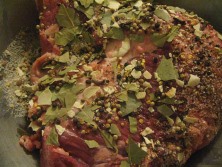
|
Origin of the Word "Corned"
The term Corned is modified from an Old Germanic (P.Gmc) Word Kurnam which meant small seed of anything. Since a kernel of rock salt look like a wheat or oat kernel size it became known as a corn of salt.
Even the word Kernel comes from this word Kurnam. or Kurnilo which meant the root of the seed.
The First Mention of “Corned Beef”
goes back to an English Book by Richard Burton in 1621, Anatomy of Melancholy...Beef ..corned young of an ox.
Corned Beef and Cabbage is basically an American tradition or Irish?
Some Irish people feel that corned beef and cabbage is about as Irish as spaghetti and meatballs while others say it has been a festive dish tradition for centuries.
The First Arguement... Brid Mahon's Land of Milk and Honey: The Story of Traditional Irish Food and Drink contains these notes about corned beef: "[in the 19th century] Corned beef was a festive dish." (p. 8) |
|
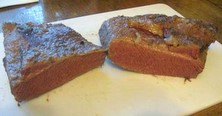 |
| "While Irish beef has always been noted for its flavor, corned beef was equally relished. Boiled and served with green cabbage and floury potatoes, it was considered an epicurean dish, to be eaten at Hallowe'en, at Christmas, on St. Patrick's Day, at weddings and at wakes, a traidtion that was carried to the New World by the emigrants of the 18th and 19th centuries. To this day, corned beef and cabbage are served on St. Patrick's Day and at Thanksgiving in parts of North America. Bacon, corned beef, sausages and pudding are all mentioned in The Vision of Mac Conlinne, the 12th-century tale that also describes the condiments served with meats." (p. 57) |
|
| There is some controversy about whether "Corned Beef & Cabbage, " often eaten in America on St. Patrick's Day is a traditional Irish meal. According to Malachi McCormick's Irish County Cooking and "The Troubles That Irish Food Has Seen," New York Times, March 14, 1990 (page C8) corned beef & cabbage is a purely American tradition. Colcannon (boiled new potatoes mixed with boiled white cabbage, boiled leeks or boiled onions to which is added butter, milk and wild garlic) is more likely to be considered Ireland's national dish. |
 
Malachi McCormick's Irish Country Cooking
|
| Stephen McFarland, author of "Just Desserts"who works with Celeb chef in Ireland Neven McGuire says that Corned Beef and Cabbage is a popular dish in modern times in Ireland and often served with Champ |
Pork over Beef In Ireland
Since cows were used for milk rather than meat in poor times in Ireland, beef was a delicacy that was fed to kings. It was more common to celebrate a holiday meal with what they call a ham (Gammon) or bacon joint. ( a cured but unsmoked piece of pork) with their cabbage and potatoes. When many Irish Immigrants came over in the mid 1800’s they couldn't’t find a bacon joint like they had in Ireland, so they found that Jewish corned beef was very similar in texture, and they used that for their holiday celebrations.
For an Irish Celebration use
a Bacon Joint
|
An Irish Bacon Joint, available here
Irish Grub
Corned Beef, A Rite of Spring
Some say that Corned beef was a great Spring celebration meal because often this cured beef sat in crocks all winter and was brought out in the Spring to celebrate.
|
Guess who really loves Canned Corned Beef ?
Some Islanders like Guam.
They love their corned beef hash. My guess is because soldiers stationed their use to
get it as rations. The natives took a liking to it and to this day they use it in recipes like
This with fried corned beef over rice with
fina'denne'. to stuffing a whole pig with canned
corned beef for a pig roast.
|
|

Learn how to make your own corned beef with this book and kit with curing and spices
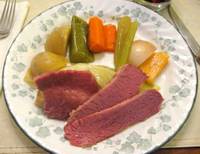
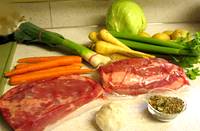
Also the Perfect Corned Beef and Cabbage
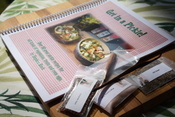
Get it all in this book, plus curing salt and spices for making your own Corned Beef.

We explore recipes, and their history and how to best make
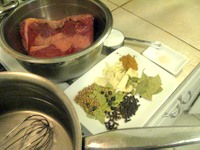
them with step by step pictures.
100% Pure Vanilla Products the Best Ever
Premium Extracts
Madagascar Vanilla Beans

Pure Ground Vanilla
My Cooking Essentials
|